

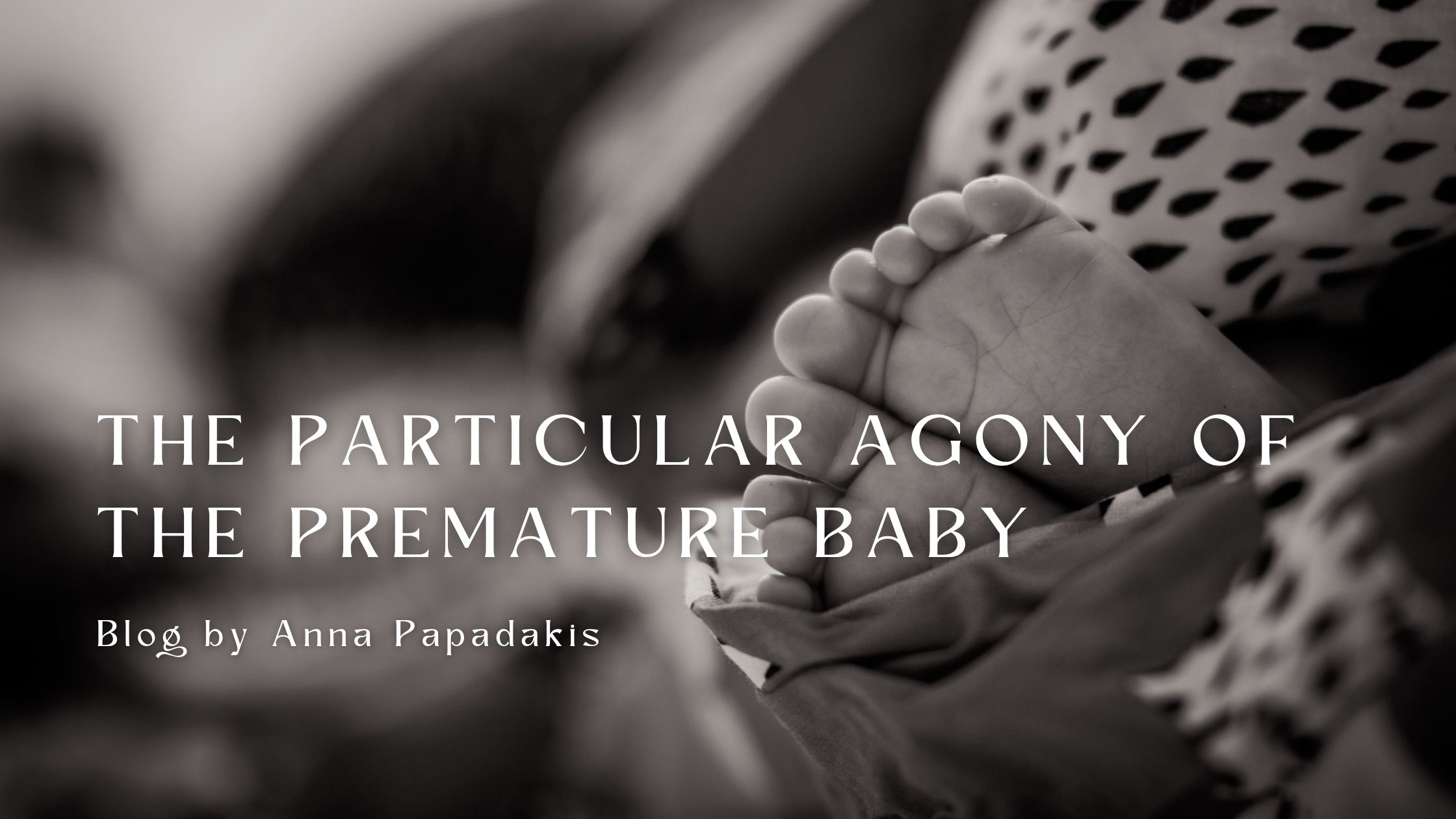
The Particular Agony of the Premature Baby
by Anna Papadakis, Body-Centred Therapist
I have been a body-centered therapist for fifteen years and was a birth worker for twelve. In that time, I have attended births, taught about birth, trained doulas, and spent decades listening deeply to people’s bodies and stories. Again and again, I have witnessed how profoundly the imprint of birth shapes us—not only in our first moments but across an entire lifetime.
Birth is not just an event; it is an intricate, intelligent design. It is an initiation of the soul into a body, at a specific time and place. The way we come into the world sets up a template for how we experience ourselves in relation to others, to our needs, to connection, and to life itself. It also forms the foundation for our worldview, our wounds, our healing, and our self-actualisation.
A newborn’s fundamental need is simple: to remain connected.
In the womb, a baby is not separate from the mother. There is no differentiation—her body is their world. They live inside her being, her cells, her sounds and the weather of her emotions. Connection is total. This is both in the full enclosure of the womb and the specific physical pressures of the tight, muscley container on the body. We are literally and viscerally held. The design for birth is that this connection continues as the baby transitions into life outside the womb.
Our first hour in the world is known as the “golden hour. ” The moment our primal imprint is set. This is why practices like undisturbed birth, skin-to-skin contact, and delayed cord clamping matter so deeply. The placenta functions as the baby’s lungs, heart, and organ support. If the cord remains intact, the transition into breathing and independent functioning unfolds at the baby’s pace. There is time for the baby to adjust, for the first breath to be taken in the mother’s arms with readiness, not pressure. Alongside this, oxytocin—the hormone of love and bonding—floods both mother and baby, embedding the sense of safety, belonging, and love that is our birthright. This sets the blueprint for how we meet and see the world: as a loving, responsive place.
When the cord is cut quickly, continuity is severed. A baby may miss out on vital oxygen and blood supply (up to 40% of their blood volume remains in the placenta at birth) creating physical pressure to replace that blood and the oxygen it carries. The transition is abrupt, often happening while the mother–baby dyad is in an adrenaline-driven state rather than a loving oxytocin-fueled embrace. For a premature baby, this rupture is magnified. Instead of being nestled in the mother’s arms—skin to skin, eye to eye—they are separated and placed in an humidicrib.
The design of our arrival into the world is body-to-body, gaze-to-gaze. A mother’s eyes, filled with love and wonder, are not just looking—they are being received. A baby can feel being seen. This gaze imprints an innate sense of worth, safety, and belonging. It is an affirmation of the baby’s very existence. The mother and baby’s heartbeat synchronise with each other. But for a preemie in a humidicrib, that gaze is replaced by strangers, machines, sterile sounds, beeping, urgency, and worry. The eyes that fall upon them are at times filled with concern and fear, not the unconditional wonder they were designed to receive.
The impact is enormous. In the separation, a premature baby may experience absolute aloneness. In isolation, The body and brain, are activated into survival mode: I have to do this alone. There is no one else. There is no source. This translates to a physiological and neurological state of profound stress. This state doesn’t stay in the incubator. It becomes a foundational belief, buried deep in the rings of the body like the core of a tree: Life is hard work. I am alone.
As adults, many people born prematurely live with this imprint without realising it. In my two decades of body-centered therapy work, I have noticed striking commonalities among preemie clients. There is often a profound hyper-independence, a relentless sense that “it’s all on me.” Needs may feel dangerous, invalid, or shameful. Connection can feel foreign, even threatening. Boundaries informed by needs, can be nearly impossible to recognise or hold.
And beneath it all, there is a deep anguish—a bone-deep loneliness that simply feels like reality itself. Because there were no words at that stage of life, the imprint is not a memory we can reason with. It simply is.
The body holds this imprint. In adult bodies of preemie babies I often feel an excruciating underlying tension, a cataclysmic urgency, as though every cell is braced, still hanging on for dear life. It is at once an unbearable urgent distress and an inescapable, hopeless trap. This is not just psychological—it is somatic, etched into the nervous system from the very first breath.
The miraculous thing about the body and the psyche is that it is never too late. The unmet needs remain alive in the body, waiting for the right conditions to be fulfilled and released. These needs may present as fatigue, depression, isolation, shame, resentment, or a sense of deserving disconnection. In body-centered therapy, we return to the deep tension of that baby: the need to be held, to be seen, to be safe. We meet those needs as they present in the body—through attuning to and feeling all of the sensations, tension, or pain—with unconditional presence, and compassion. And we simply stay with it. Unconditional presence is love. Deep attunement creates a container of oxytocin where frozen states can begin to melt.
When we learn to recognise the truth—that our agony comes from a tiny, isolated baby—we can meet those sensations with tenderness. From there, the lifelong belief that “I am utterly alone” can begin to transform. Slowly, the body learns that connection is possible, that needs are valid, and that there is love and supply in the world. All trauma, paradoxically, carries the potential for healing and to shape our evolution—connecting us to our soul’s purpose, to our true nature, and to the unique capacities we bring to the world.
One of my clients who was born premature, has been working with Body Centred Therapy for over eight years. She has described it as revelatory to recognise that the struggles she had carried throughout her life were, in fact, the echoes of the agony imprinted in her system from those earliest moments of separation. Although it has been extremely challenging for her to feel those sensations within that context, it has also been profoundly healing. With unconditional attunement, offered gently and consistently over time, she has been able to build trust, slowly feel her brain rewire, and begin to experience safety in the world. She emphasises that it is a slow process and it is the deeply trusted attunement over a long period of time that matters. Through this process, her sense of existence and her relationships have transformed into ones where she truly knows that she matters.
The agony of being born premature is real. It is profound, and it is foundational. But it is not beyond repair. With tenderness, presence, and compassion, the imprints of birth can be softened, and the story can evolve.
Advice for Parents of Premature Babies
If your baby was born premature, or if they spent time separated from you in NICU (even briefly), there are ways you can support them so they carry less of the imprint of that early separation—and ways you can help unwind it as they grow.
Often, these babies appear to be “easy” sleepers or seem unusually independent from a very young age. Rather than celebrating this, see it as a sign of how early they learned to cope on their own. What they truly need is connection.
When you begin offering more closeness—holding them more, wearing them in a sling, spending more skin-to-skin time—you may notice more tears and upset. This is not a step backwards. It is a healing response: your baby beginning let go of deep survival tension and to trust that they don’t have to manage alone anymore.
Practical ways to reconnect:
- Baby-wearing: keep your baby close to your body so they can feel your heartbeat and warmth.
- Bathing together: a warm bath together recreates something of the amniotic experience and can be deeply soothing.
- Skin-to-skin time: let your baby rest against your chest, helping their nervous system regulate with yours.
- Co-sleeping: safe co-sleeping can provide the continuous proximity of body-to-body reassurance your baby missed in their earliest days.
- Extra touch: offer lots of firm, loving contact—deep massage, full-body holding, and gentle pressure all over the body. These grounding sensations help your baby feel safe and rebuild a sense of wholeness.
- Seeing through hyper-independence: notice if your child seems unusually self-sufficient or “doesn’t need much.” Recognising this as a coping pattern—and letting them be seen in it—can be profoundly healing. Being witnessed and understood is a remedy in itself.
- Responsive holding: even if it means more crying at first, meeting them with your presence and arms helps repair the bond. These practices give your baby the message they may have missed at birth: “You don’t have to do this alone. I am here.”
For You, Dear Parent
If you are a parent of a baby or child born premature, it may be distressing if your baby becomes upset, because you too have been holding on tight since your baby was born. You too have suffered the agony of disconnection that has gone against the natural order of things. You have also been in survival mode, and you too need support to feel safe again.
For you I recommend:
- Cry with them: Let your baby’s cries reach your own pain and cry with them. Let your tears flow together; in this way, you can begin to let go.
- Validate your need for support: It can take a while to be ready to get support for your own trauma of all that it took for you to bare being separated from your baby. When you are ready, somatic therapy as well as specialist birth debriefing can be ideal.
- Connect to your sensations: Remember, it is not too late to connect. We do this on the instinctual level in the sensory realm—through touch, sounds, eye gazing, and feeling all of the sensations you feel around your baby.
Advice for Adults Born Premature
If you were born premature, you may recognise yourself in this description: profoundly self-reliant, hyper-independent, deeply responsible, yet carrying an invisible loneliness that feels like reality itself. These are not character flaws; they are the intelligent adaptations of a tiny baby who had to survive without the closeness they were designed to receive.
Healing begins with recognising that what you carry is not “just who you are”—it is an imprint. And imprints can be softened.
Ways to begin your own healing:
- Somatic therapy: working with the body allows you to reconnect with sensations that were frozen at birth, and to experience them being met and felt with compassion and presence.
- Create safety in relationships: allow yourself to risk connections where your needs are welcome and where vulnerability is safe. Letting yourself lean on another person, even in small ways, begins to unwind the old imprint.
- Touch and holding: massage, bodywork, or even weighted blankets can offer the grounding reassurance your nervous system once missed.
- Eye contact and presence: allowing yourself to be truly seen by another—whether in therapy, intimate relationships, or spiritual practice—helps restore the missing imprint of being met, gaze to gaze.
- Self-compassion practices: when you notice the voice that says “I have to do this alone,” gently remind yourself: This is how I felt as a baby. Feel the sensations that come up at that moment. This way you bring compassion and attunement directly to preemie baby inside or your.
The journey of healing from a premature birth is profound. It is not about erasing the past but about bringing tenderness to what was missing, and allowing your body to learn—often for the very first time—that you are not alone.
About the Author
Anna Papadakis is a body-centred therapist living in Melbourne Australia. The foundation of her somatic practice is the understanding that unconditional presence is the love that meets unmet needs. From here the natural intelligence of the body transmutes trauma and creates and new possibilities. She specialises in exploring how the imprint of birth shapes us throughout our lives, and in supporting healing through presence, attunement, and compassion. Find out more at
Connect with Anna Papadakis
If your soul calls for deep repair, embodied healing, and reintegration, Anna offers body-centred therapies and supportive modalities to guide you home to yourself.
✨ Body-Centred Therapy & Somatic Healing
Through trauma-informed, body-aware practices, Anna helps you release held patterns, reclaim internal resources, and re-embody wholeness.
Learn more about Anna’s therapies
Movement, Breath & Somatic Practices
Integrative sessions may include breathwork, embodied movement, gentle somatic processing, nervous system regulation and more — tailored to your healing edge.
For schedule, fees, and booking details, explore here or contact us directly.
Anna Papadakis
Somatic Therapist & Body-Centred Healer
️ Sessions available at Kundalini House
annapapadakis.com.au


Leave A Comment