What is the difference between Tai Chi and Qi Gong?
This is probably the most common question I’m asked, and it usually comes soon after I have mentioned Qigong during a Tai Chi class (or vice-versa). Bearing in mind that this is only one person’s understanding, below are a few points of discussion:
What is Tai Chi?
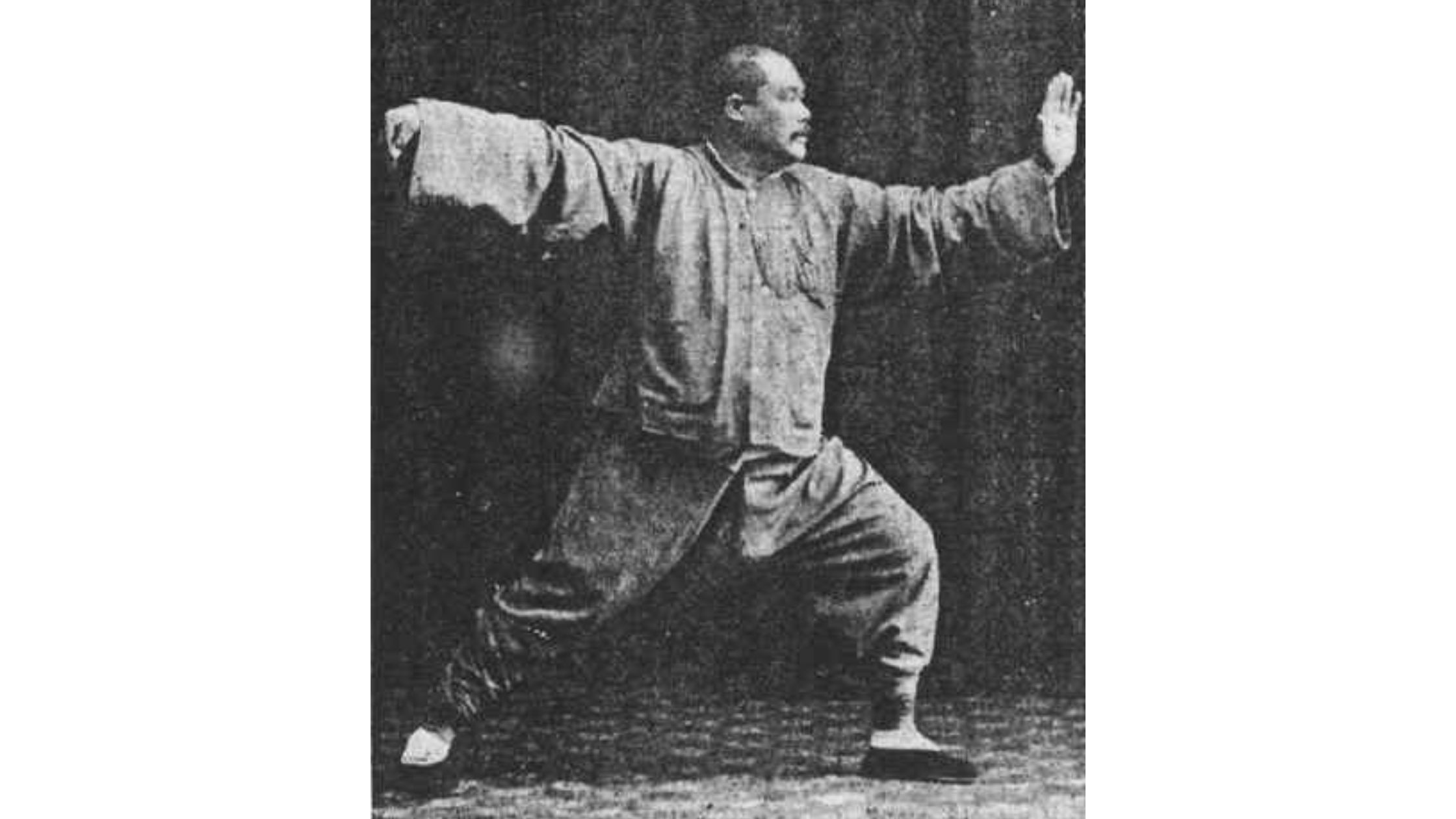
Yang Chen Fu practicing the Tai Chi posture Single Whip
Tai Chi (taijiquan – “Supreme Ultimate Fist”) has a martial arts origin and framework. There is still some debate about the origins of Tai Chi, but most agree that modern versions of the art have a common origin in the Chen family village in Southern China. The Chens developed Tai Chi as a dynamic and effective martial art, and provided for their families by hiring themselves out as bodyguards and protection against bandits for travelling merchants. The Chens are still active today, and most other popular forms are variations on their principles and practices.
In modern times, the emphasis on self-defence has lessened (though the potential is still there), and the vast majority of practitioners pursue a slow, and mindful Tai Chi practise for health purposes, whether of the physical, emotional, mental or spiritual kind. At its highest level, Tai Chi becomes a kind of Qigong, and a form of moving meditation.
Tai Chi tends to be categorised either by length (Short, Medium and Long forms), or by its family style/school: (Chen, Yang, Wu, Sun, Hao, or combination forms). As well as the basic forms, there may be “ancillary” forms, such as various weapons, partnered training, fast Tai Chi forms, and combat drills.
What is Qi Gong?
Ancient manuscripts depicting Qigong practice
Qigong is the modern umbrella term for various health and self-development practices originating in China and correlating with the principles of Chinese Medicine. “Qi” refers to the vital energy which animates and sustains us (and everything else), while “gong” translates as work, talent, or skill. So it’s essentially “energy work”, which is the perfect broad description for such a diverse collection of esoteric techniques. Qigong forms tend to be categorised in one of two ways (examples in italics):
Characteristics:
- Active. The emphasis is on movements and postures to activate and regulate one’s energy, e.g. Ba Duan Jin
- Passive. More closely aligned with meditation, though rather than achieving a calm/still mind, the aim is to mentally work with one’s internal energy, e.g. Xiao Zhou Tian
- Standing postures. The adoption of sometimes physically demanding postures to stimulate energetic movement and development, e.g. Fan Tung
- Walking. Used either as a meditative technique or to target a particular disease, e.g. Guo Lin
Origin/purpose:
- Taoist. Primarily oriented towards self-development, and accessing one’s latent natural abilities, with the ultimate goal of enlightenment, e.g. Yin Yang Wuxi
- Buddhist. Less physical and more spiritual practices, aimed at correcting one’s karma and understanding the nature of being, e.g. “Sword Fingers” Tibetan Buddhist meditation
- Confucian. Creating citizens who consciously work for the betterment of society as a whole, e.g. Zuo Wang
- Medical. A variety of practices aimed either at healing specific diseases, or improving one’s health more generally, e.g. Liu Zi Jue
- Martial Arts. Cultivating the ability to absorb and deliver blows without damage, and keeping a calm mind under duress, e.g. “Iron Body” training
Beginner-level Qigong practice usually involves simple forms, which can be practiced by most people, and they will experience some benefits in the areas of relaxation, strength & flexibility, stamina, vitality, calmness, and ability to cope with stress. Intermediate and advanced-level forms are best trained under an experienced and reputable Master or instructor, as individuals will have different experiences and challenges during their training, which the Master will be able to adapt to best suit their development and avoid undue hardship.
There are certainly many areas of crossover between Tai Chi and Qigong, and regular practitioners of both find the two to be quite complementary. Qigong practice can add sensitivity and energetic awareness to Tai Chi, while Tai Chi training can “bring to life” a bodily awareness of some of the more subtle aspects of Qigong development and harmonise disparate aspects of one’s energetic system. I personally would find it difficult to choose between Tai Chi and Qigong, and tend to go through phases of concentrating more on one or the other. Some beginners struggle to remember the details of the Tai Chi form (it’s not as easy as it looks!), and may therefore benefit from training in a simple Qigong form first, to increase their bodily awareness and build some strength and confidence, before returning to tackle Tai Chi training with more success.
If you are interested in either or both of these wonderful methods of self-improvement, please get in touch via Kundalini House. Or join us for a Qi Gong class either in person in our beautiful studion or online.
 Simon is a registered, experienced Doctor of Chinese Medicine, and an Instructor of Qigong (many kinds) and Tai Chi (Yang and Dong styles). Simon is available for individual Chinese Medicine appointments in the Kundalini House Clinic. Simon also teaches a Qigong class in the Kundalini House Studio, and will soon be offering an in-depth training in the Self-Healing Qigong form, as well as a “starter” intensive on Yang Style Tai Chi. Please contact us to register your interest in any of the above. info@kundalinihouse.com.au



Leave A Comment