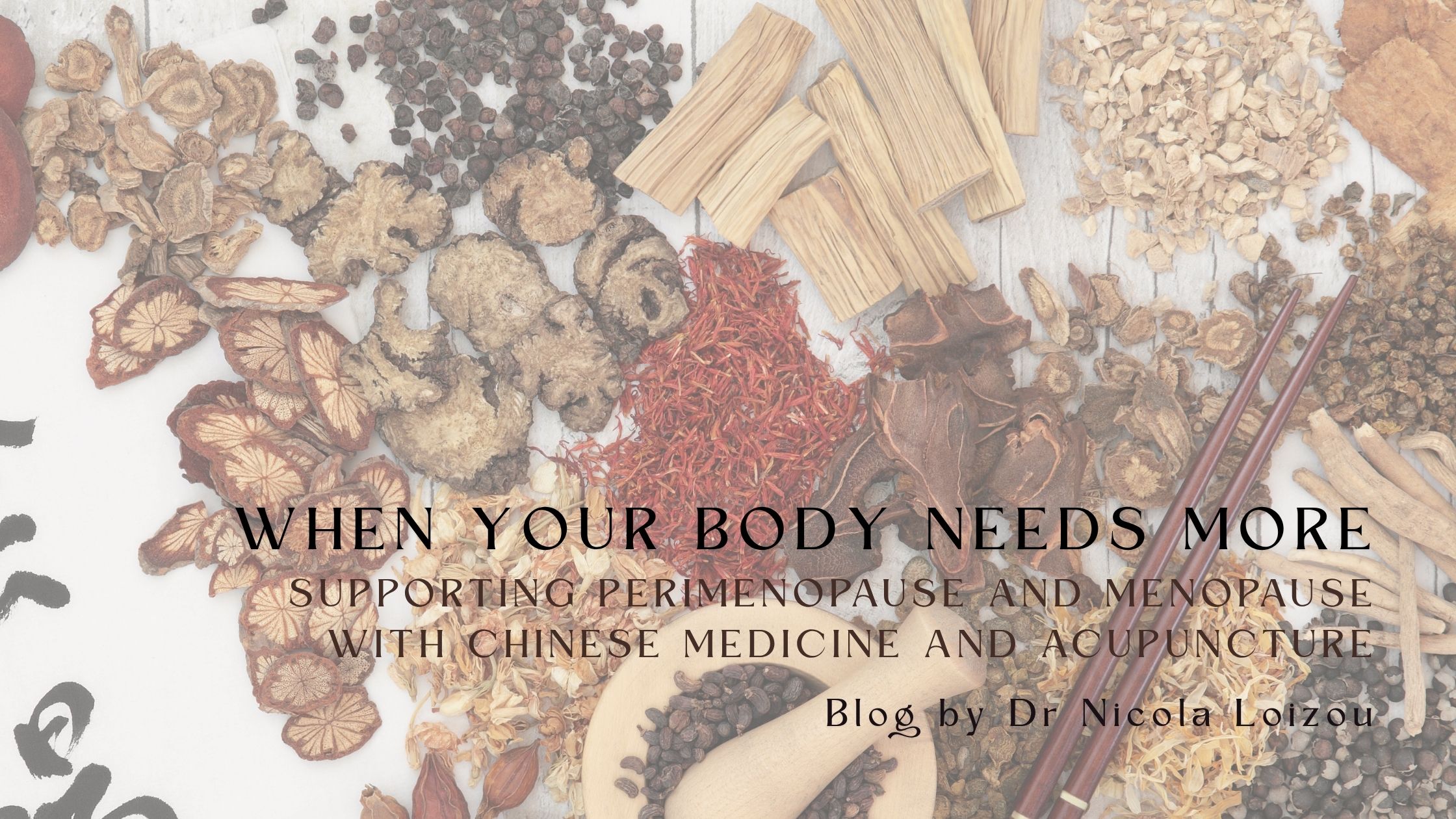
When Your Body Needs More: Supporting Perimenopause and Menopause with Chinese Medicine and Acupuncture
By Dr Nicola Loizou
Perimenopause and menopause are natural transitions, but for many women, they bring a cascade of symptoms that can feel overwhelming and unpredictable. While hot flushes, mood swings, weight gain and night sweats are well-known, you might be surprised to learn that frozen shoulder, joint pain, digestive issues, skin problems, persistent headaches, brain fog, and fatigue can all be connected to hormonal shifts during this time.
If you’re experiencing these symptoms—or know someone who is—Traditional Chinese Medicine (TCM) and acupuncture may offer a holistic, trauma-informed approach that addresses the root causes, not just individual symptoms. My work focuses on helping women who are suffering daily with these symptoms to reclaim their quality of life and find ease in their bodies again.
The Unexpected Face of Hormonal Change
Most women expect hot flushes and irregular periods during perimenopause, but the inflammatory cascade that can accompany hormonal decline often catches people off guard. Suddenly you’re dealing with:
- Musculoskeletal inflammation: Frozen shoulder, joint pain and stiffness, particularly in shoulders, hands, knees, and hips
- Digestive disruption: Bloating, changes in bowel habits, food sensitivities that never existed before
- Skin issues: Dryness, increased sensitivity, breakouts, or inflammatory conditions
- Persistent headaches or migraines: Often worse around what used to be your cycle
- Brain fog and memory issues: Difficulty concentrating, finding words, or feeling mentally sharp
- Sleep disturbances: Insomnia, waking frequently, or non-restorative sleep
- Mood changes: Anxiety, irritability, or low mood that feels different from depression
- Crushing fatigue: The kind that doesn’t improve with rest
These seemingly unrelated symptoms are all part of the same picture—your body signalling that it needs more support during this significant transition.
Understanding the Chinese Medicine Perspective
Chinese medicine views menopause not as a disease or deficiency that needs fixing, but as a natural life transition where the body’s resources are being redirected. However, when you arrive at this transition with an already depleted system, symptoms arise.
The women I see most affected are those who’ve been running on empty for years—managing high-pressure careers, carrying the mental and physical load of family life (what’s often called the “Mother Load”), and prioritizing everyone else’s needs above their own. By the time perimenopause arrives, the tank is empty, and the body simply doesn’t have the resources it needs to navigate this transition smoothly.
This chronic depletion isn’t just physical—it often carries an emotional and nervous system component as well. Years of stress, pushing through, and not feeling heard or supported can leave the body stuck in protective patterns. A trauma-informed approach recognizes that healing requires more than treating symptoms; it means creating a safe space where your nervous system can finally regulate, and your body can begin to trust that it’s okay to let go and restore itself.
In TCM theory, menopausal symptoms are often understood through these key patterns:
Kidney Yin and Yang Deficiency: The Kidneys in Chinese medicine govern reproduction, aging, and vital essence. As we age, Kidney Yin (the cooling, nourishing aspect) and Kidney Yang (the warming, activating aspect) naturally decline. When Kidney Yin is deficient, we see hot flushes, night sweats, insomnia, and anxiety. When Kidney Yang is deficient, we see fatigue, cold intolerance, low libido, and depression. Often both are depleted simultaneously.
Blood Deficiency: Blood in TCM nourishes tissues, calms the mind, and moistens the body. Blood deficiency can manifest as dry skin, vaginal dryness, poor memory, anxiety, insomnia, and joint stiffness.
Liver Qi Stagnation: The Liver governs the smooth flow of Qi and emotions. When stressed and depleted, Liver Qi becomes stuck, leading to irritability, mood swings, breast tenderness, headaches, and digestive issues.
Spleen Qi Deficiency: Years of stress, poor nutrition, and overwork deplete the Spleen’s ability to transform food into Qi and Blood. This results in fatigue, digestive problems, brain fog, and weight gain, particularly around the middle.
The inflammatory symptoms—joint pain, digestive issues, skin problems, headaches—arise when these deficiencies and imbalances trigger the body’s stress response. Without adequate resources, the body perceives threat and activates inflammation as a protective mechanism. For women who’ve experienced chronic stress or past trauma, this inflammatory response can be even more pronounced, as the nervous system remains vigilant and reactive.
How Acupuncture and Chinese Medicine Help
Treatment focuses on “refilling the tank”—giving your body the nourishment, balance, and support it needs to function optimally again. Equally important is creating an environment where your nervous system feels safe enough to move out of chronic stress patterns and into restoration mode. When the body has these resources and feels safe, physical processes run smoothly, and symptoms stop being roadblocks to living with ease.
Acupuncture uses ultra-thin, single use needles at specific points to:
- Nourish Kidney Yin to reduce hot flushes, night sweats, and anxiety
- Tonify Kidney Yang to restore energy, warmth, and vitality
- Build Blood to improve sleep, mood, cognitive function, and tissue health
- Harmonize Liver Qi to reduce irritability, headaches, and digestive issues
- Strengthen Spleen Qi to improve digestion, energy, and metabolism
- Regulate the nervous system, helping it shift from freeze, fight-or-flight into rest-and-restore
- Reduce the inflammatory cascade that perpetuates symptoms
- Support hormone balance naturally
- Improve sleep quality and duration
- Create a sense of safety and calm in the body
Chinese Herbal Formulas are customized to your specific pattern and may address multiple imbalances simultaneously. Classical formulas have been refined over centuries specifically for menopausal transitions and can be remarkably effective for reducing symptoms.
Nutritional Support may bridge critical gaps. I incorporate evidence-based supplements and vitamins that support cellular health, hormone production, bone density, and inflammatory regulation. When combined with acupuncture and herbs, these create the building blocks your body needs.
Lifestyle Guidance addresses stress management, exercise guidelines, sleep hygiene, and dietary choices that either support or deplete your system during this transition.
What to Expect from Treatment
Treatment is individualized based on your unique presentation. Some women need more Yin nourishment, others need Yang support, and many need both along with Qi and Blood building. The goal is always to restore balance and give your body what it’s been missing and make changes to keep it that way.
From the first appointment, I work to create a nurturing, relaxed environment where you feel heard and supported. Many women have spent years not being taken seriously when describing their symptoms, or being told “it’s just menopause” without real solutions. A trauma-informed approach means I listen deeply, validate your experience, and work collaboratively with you to address what matters most.
Many women notice improvements within the first few treatments—better sleep, reduced hot flushes, improved energy, or less joint pain. As treatment continues and your body’s reserves rebuild, the changes deepen. Inflammation subsides, hormones stabilize, energy returns, and that persistent brain fog lifts. Equally important, women often report feeling more like themselves again—calmer, more grounded, and more at ease in their bodies.
This isn’t about managing symptoms forever—it’s about restoring your body’s capacity to regulate itself so you can move through this transition and beyond with vitality and ease.
Finding Ease Again
Perimenopause and menopause don’t have to mean years of suffering. When you’ve spent decades giving to others, running on empty, and pushing through, your body deserves support that addresses the depletion at its root.
Chinese medicine offers a pathway back to balance—one that honors the transition you’re in while addressing the depletion at its root. With the right support, symptoms can resolve, energy can return, and you can reclaim clarity and comfort in your own body. Life can feel easy again.
Dr Nicola Loizou has been practicing Chinese medicine since 2011 with a specialization in women’s health and chronic diseases. She practices at Kundalini House in Fitzroy North, Melbourne, where she provides integrative, trauma-informed care for women navigating hormonal transitions, including perimenopause and menopause.
Contact her directly:
Email: hello@nicolaloizou.com.au
Phone: 0414230559


Leave A Comment