
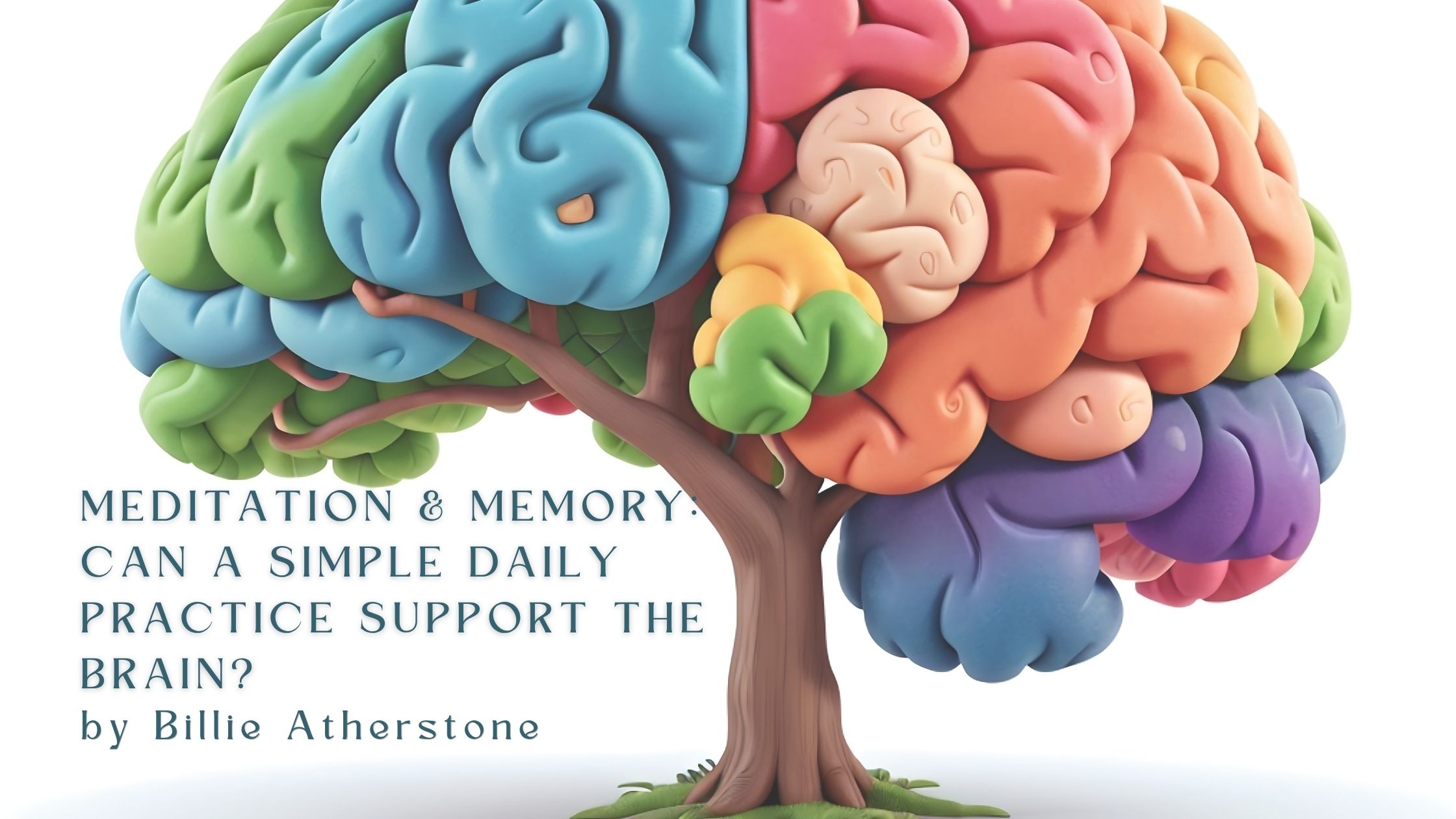
Meditation & Memory
Can a simple daily practice support the brain?
We are living in a time of high cognitive demand.
Constant information. Fast pace. Global uncertainty.
Many of us are holding more than ever before—mentally, emotionally, and physiologically.
From a nervous system perspective, this builds what we call allostatic load—the cumulative burden of stress on the body and brain.
Over time, this begins to impact memory.
Not dramatically at first. Subtly.
Forgetting names. Losing words. Difficulty concentrating. A sense of mental fatigue.
This is not something to fear—but it is something to understand.
Stress and the Memory Centres of the Brain
Chronic stress affects the hippocampus, a region deeply involved in learning and memory. (1)
Elevated cortisol over time can reduce hippocampal volume and impair memory consolidation.
At the same time, stress increases activity in survival-oriented brain regions, pulling energy away from higher cognitive function.
In simple terms:
Stress prioritises survival over memory.
Rhythm as Regulation
Meditation offers a different pathway.
Practices that combine sound, breath, rhythm, and attention help regulate the nervous system and restore balance.
Kirtan Kriya (KK) is one of the most studied Kundalini meditations in this area.
It is simple, structured, and rhythmic:
- Mantra (Sa Ta Na Ma)
- Finger movements (mudra)
- Visualisation
- Breath awareness
This combination engages multiple areas of the brain simultaneously.
If you’re new to Kirtan Kriya, you can learn the full practice here:
Read: What is Kirtan Kriya + How to Practice
What the Research Suggests
Research into Kirtan Kriya, including work supported by the Alzheimer’s Research & Prevention Foundation, has found: (2)
- Increased blood flow to the posterior cingulate gyrus (PCG)—a key region for memory and one of the first affected in cognitive decline
- Improved functional connectivity within the Default Mode Network (linked to memory and self-referential processing)
- Enhanced activity in the prefrontal cortex, supporting attention and executive function
- Improvements in verbal memory in adults with subjective memory decline
- Increased telomerase activity, associated with cellular health and longevity
These findings suggest that even 12 minutes a day can begin to positively influence brain function.
A Different Way to Think About Practice
Rather than striving for a perfect meditation…
Think of it as daily hygiene for the mind.
Just as we clear physical waste from the body, meditation helps process and release mental and emotional accumulation.
Some days the mind will feel busy.
Some days it may feel clear.
Both are part of the process.
Consistency matters more than experience.
Early Awareness, Not Fear
Memory changes can be part of normal ageing—but they can also be an early signal that the nervous system is under strain.
Bringing awareness early allows for support, intervention, and care.
At Kundalini House, we offer a range of complementary therapies that support:
- Cognitive health
- Nervous system regulation
- Emotional wellbeing
You are not meant to navigate this alone.
Explore our clinic and therapeutic services here:
View Kundalini House Clinic Offerings
Practice With Us
As part of our year-long focus, we are inviting our community into a shared daily practice:
12 minutes of Kirtan Kriya
Not as another task to complete—
but as a steady, supportive rhythm in your day.
A way to regulate the nervous system.
Support the brain.
And gently strengthen memory over time.
Start your practice with our guided introduction:
Watch: Kirtan Kriya Intro + Practice with Billie
Or revisit the full breakdown of the meditation here:
Read: Kirtan Kriya Practice Guide
Stress can impact memory.
Rhythm can restore it.
Let this be a small, consistent step toward clarity, steadiness, and long-term brain health.
Warmth,
Billie Atherstone (Siri Bhagvati)
Yoga Therapist (C-IAYT), Kinesiologist & Bowen Therapist
Associate Investigator – MANTRA Study
Kundalini House | Melbourne
References:
(1)
- Lupien, S. J., et al. (2009).
Effects of stress throughout the lifespan on the brain, behaviour and cognition.
Nature Reviews Neuroscience, 10(6), 434–445.
→ Found strong evidence that prolonged cortisol exposure is associated with hippocampal atrophy and memory impairment. - McEwen, B. S. (2017).
Neurobiological and systemic effects of chronic stress.
Chronic Stress, 1.
→ Describes how allostatic load and chronic stress reshape brain structures, particularly the hippocampus. - Sapolsky, R. M. (2000).
Glucocorticoids and hippocampal atrophy in neuropsychiatric disorders.
Archives of General Psychiatry, 57(10), 925–935.
→ Links elevated glucocorticoids (cortisol) to reduced hippocampal volume and impaired memory consolidation.
(2)
Kirtan Kriya & Brain Function (ARPF + Khalsa et al.)
Much of the Kirtan Kriya research comes from Dr. Dharma Singh Khalsa and collaborators, often supported by the Alzheimer’s Research & Prevention Foundation (ARPF).
Blood Flow to Posterior Cingulate Gyrus (PCG)
- Newberg, A. B., et al. (2010).
The measurement of regional cerebral blood flow during meditation: Kirtan Kriya.
Journal of Alzheimer’s Disease, 20(2), 517–526.
→ Demonstrated increased cerebral blood flow, including the posterior cingulate gyrus, after KK practice. - Khalsa, D. S. (2015).
Stress, meditation, and Alzheimer’s disease prevention: Where the evidence stands.
Journal of Alzheimer’s Disease.
→ Reviews KK and meditation as potential tools for cognitive decline prevention.




Leave A Comment