
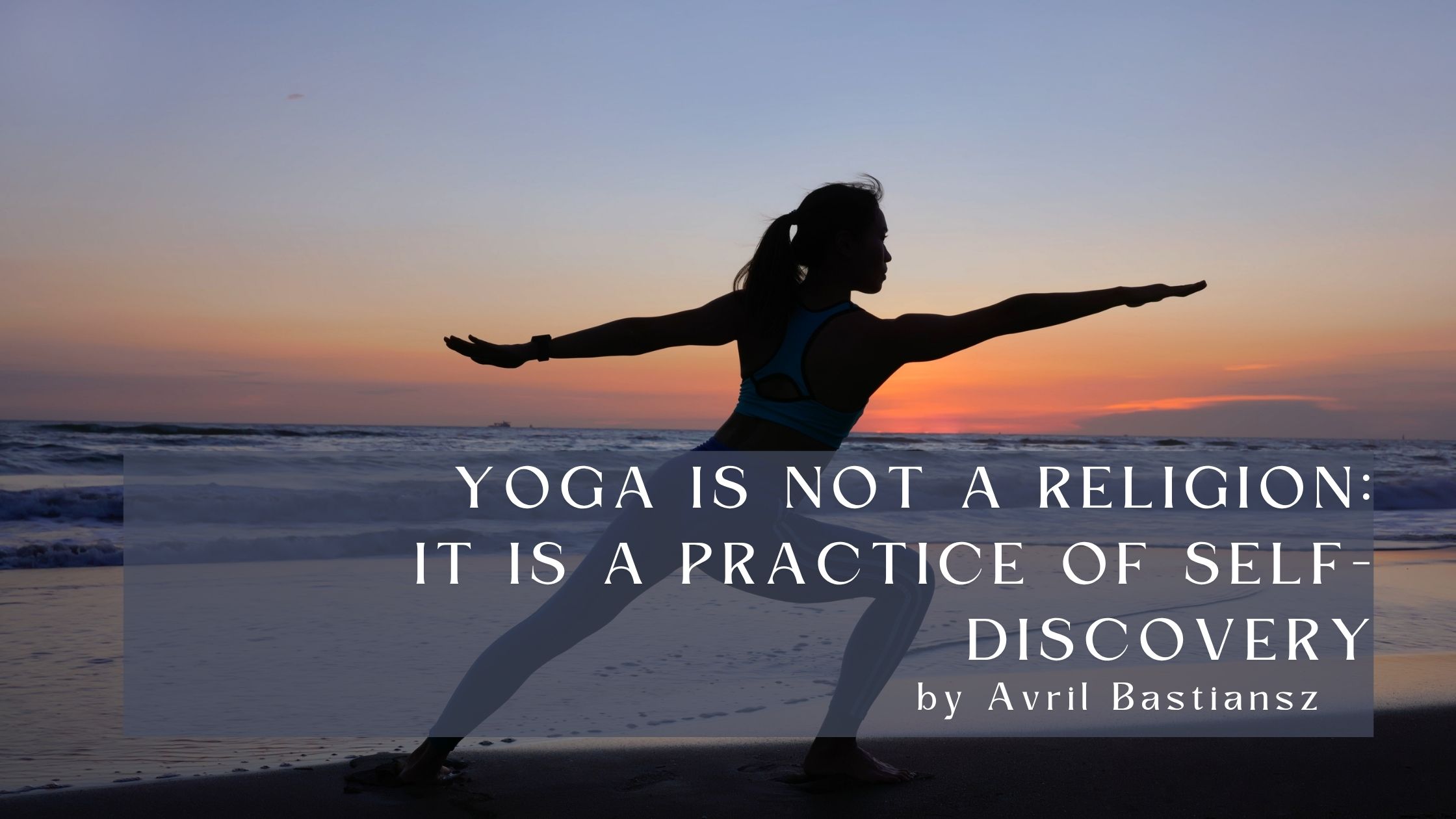
Yoga Is Not a Religion:
It Is a Practice of Self-Discovery
by Avril Bastiansz
“Yoga is not a religion; it is not just a system of exercise to keep the body fit or to cure minor physical disorders. Yoga is a discipline for the fullest development of the soul, mind, and body. Yoga is a scientific, holistic approach to life.”
— Swami Rama, Sadhana: The Path to Enlightenment
Yoga is often misunderstood; some people see it simply as exercise, others assume it is a religion, others still dismiss it as something vague, mystical, or a little too far removed from ordinary life. But yoga, in its truest sense, is none of these things in the way they are often imagined. It is a path of practice, inner refinement, and self-understanding. Perhaps the most common confusion, though, is the idea that yoga is a religion, this is understandable, Yoga comes from India and is often accompanied by Sanskrit, chanting, meditation, symbolism, mythology, philosophy, and ritual forms that can, from the outside, appear religious. In modern life, where these elements are often encountered in fragments and without much context, it is easy to see how this assumption arises. And yet yoga, in its essence, is not a religion.
Religion, as most people understand it, usually involves faith, worship, doctrine, or belonging to a particular tradition. Yoga does not require any of that. It does not ask anyone to convert, nor does it demand the abandonment of one’s own faith tradition. Yoga begins with practice. It begins with observation, discipline, and direct experience. In this sense, religion often begins with belief and then moves into practice.
Yoga begins with practice and, through practice, understanding begins to unfold. Yoga does not impose rules from the outside, but cultivates self-direction, self-governance, and ultimately self-liberation through self-awareness.
It is not necessary to believe in yoga for it to begin working. One practices, and through practice its effects become visible. The breath affects the mind and the body stores tension, the nervous system can soften, attention can be trained and reactivity can give way to steadiness. Beneath the noise and agitation of life, something quieter and more stable begins to reveal itself. This is why yoga is better understood as a discipline than as a religion. This does not mean yoga is merely physical, nor that it can be separated from the philosophical tradition that supports it. Quite the opposite. Yoga is far more than exercise, and its depth depends upon the vision that underlies the practice.
Part of the confusion today is that yoga is often presented through symbols, mythology, ritual forms, and spiritual imagery without enough explanation. People encounter these outer forms and understandably assume that yoga must therefore be a religion. But these surrounding expressions should not be mistaken for the essence of yoga itself. Yoga does arise from a rich sacred and philosophical tradition, and that tradition matters deeply. Without philosophy, yoga can easily be reduced to technique, fitness, relaxation, or lifestyle branding. The teachings of yoga help us understand the nature of the mind, the causes of suffering, the purpose of discipline, and the possibility of freedom.
That philosophical depth, however, is not the same thing as religion. A philosophical tradition invites enquiry, reflection, discernment, and lived understanding. It asks us to look, to question, to practise, and to come to know. It does not necessarily ask for worship, conversion, or adherence to a faith identity. This is an important distinction. Yoga may sit within a sacred cultural world, but it is not therefore a religion. Its symbols, stories, and ritual expressions may accompany the path, enrich it, or communicate subtle truths, but they are not what make yoga.
What makes yoga yoga is the discipline itself: the refinement of body, breath, mind, and attention; the study of our patterns; the cultivation of steadiness; and the gradual unfolding of deeper understanding. This is also where yoga’s spiritual dimension becomes more apparent. Yoga is spiritual, but spirituality is not the same thing as religion. In this context, spirituality is about the direct exploration of life’s deeper questions: Who am I? What is the nature of the mind? Why do we suffer? What lies beneath fear, conditioning, and attachment?
Yoga invites these questions not through dogma, but through practice and enquiry. It asks for honesty, quietness, observation, and inward availability. It asks that the movements of the mind be studied, and it cultivates clarity, steadiness, humility, discrimination, and inner freedom. This is why Swami Rama describes yoga as “a scientific, holistic approach to life.” Not scientific in the narrow modern sense alone, but scientific in the sense that yoga offers a method. It asks that the experiment of practice be undertaken and that the results be observed directly. It is systematic. It is experiential. It is transformational. In this sense, yoga is not a creed to adopt, but a discipline to be lived.
Yoga has developed within a sacred cultural and philosophical context. Its roots deserve to be honoured and understood. To strip yoga of its depth and reduce it to stretching is to misunderstand it, but to assume that because it is sacred it must therefore be a religion is also a misunderstanding. Yoga is not asking anyone to join a religion, it is asking us to become available to truth. For some, yoga begins as exercise, for others, it begins as stress relief, healing, or a longing for something deeper. All of these are valid entry points, but over time, sincere practice reveals that yoga is far more than movement. It becomes a process of integration, a return to wholeness, and a preparation for deeper self-knowledge.
Yoga does not ask, What must I believe?
It asks, Can I practise?
It asks, Can I observe clearly?
It asks, Can I live with greater awareness?
It asks, Who am I, truly?
Yoga is not a religion. It is a path of practice, transformation, and remembering.
That is what makes yoga not only relevant but deeply needed at this time.




Leave A Comment